

Giving You Those Perfect Ringlets
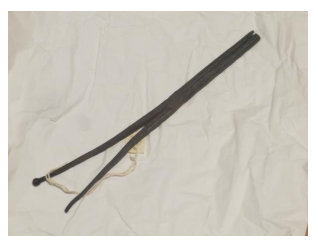
Curling hair and beards dates back centuries. Evidence of this can be found in ancient Egyptian, Greek, and Assyrian cultures. The museum's collection has two curling irons from the mid to late 19th century that can be used to understand fashion and its role in culture.
This type of curling iron had to be heated on a stove top. Prices varied from $3.00 to $6.00 and were often sold in packs. This reflected the limited nature of the device as it could cool off too much before one finished curling their hair. Such heating methods often resulted in burned hair, scalps, and hands. Only after electricity became widespread did the need for these types of irons, and the need for multiple irons, cease.
Class, Race, and "Correct" Hair
These curlers also reflected a woman's social status and issues of race in the United States. The time needed to use these curlers meant only those with maids could afford daily elaborate hair care. Lower-class women only styled their hair with curlers for special occasions. Race also played a role in these items. During the era of Reconstruction and into the early 1900s, African American women of the middle and upper class embraced the costuming of the “perfect Victorian woman.” The texture of African American hair did not lend itself to the Victorian woman's hairstyle. Their hair needed to be straightened before being curled through intense heating and, later on, chemical methods. Some women chose to shave their hair and wear wigs instead. By the mid-20th century, the Civil Rights movement brought a change in African American hairstyles and the need to conform to the white feminine look. More women openly embraced styles suited for their hair needs and felt less pressured in some places to display white hairstyles.

"Moral - Don't Use Curling Irons" News and Observer, Raleigh, N.C. Vol. 38 Issue 102. 21 May 1895.
Sources
Barlow, Ronald S., ed. Victorian Houseware, Hardware, and Kitchenware: A Pictorial Archive with Over 2000 Illustrations. Dover Publishers, Inc.: Toronto, Canada. 1992.
Carlson, Shirley J. “Black Ideals of Womanhood in the Late Victorian Era.” The Journal of Negro History. 77. 2: 1992. Accessed on 20 February 2018.
Sherrow, Victoria. Encyclopedia of Hair: A Cultural History. Greenwood Press: Westport, CT. 2006. Accessed on 20 February 2018.